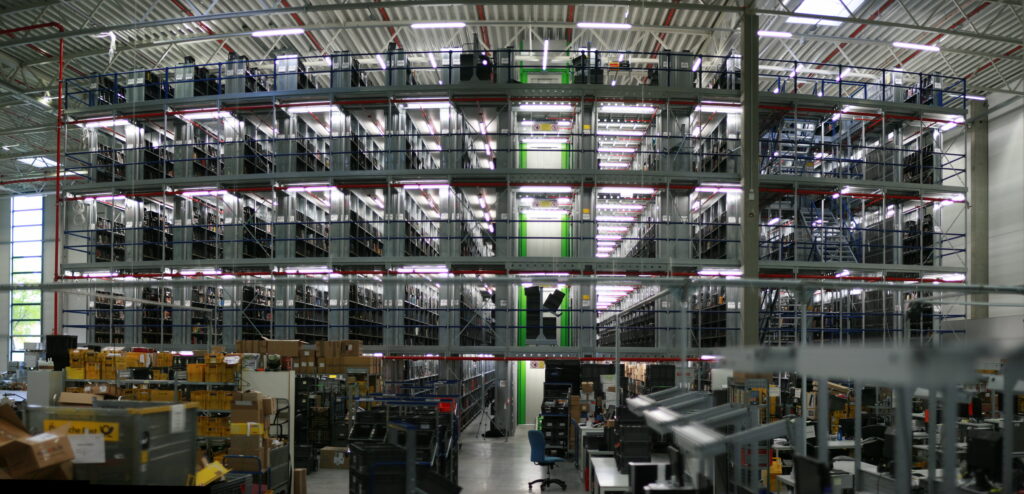
reBuy reCommerce GmbH is a rapidly growing company that was founded in 2004 under the name trade-a-game GmbH to buy and sell used game consoles and DVD games. As part of the expansion of its product range in 2009 to include various used goods such as books, cell phones, etc., the company was also renamed. The successful business model led to several relocations before the company moved into its current facility, built in 2012, where today, with 300 employees, up to 8 million different items are stored and picked across approximately 9,000 square meters of logistics space.
Technical Specifications
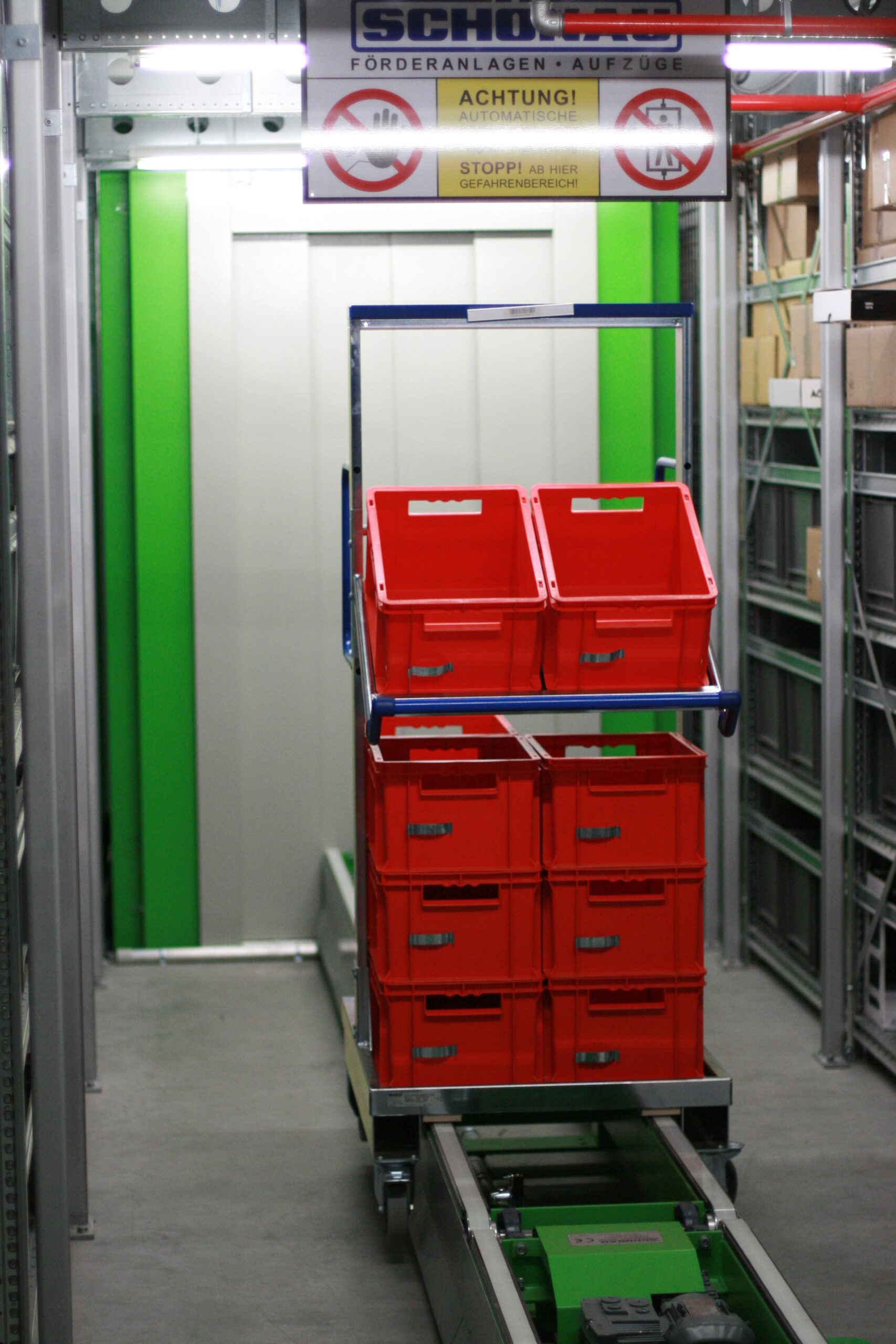
Cargo: Custom-designed carts
Dimensions (L x W x H): 950 x 656 x 1,650 mm
Weight: max. 310 kg
Throughput: 2×60 doubles matches/hour
Operating conditions: +5 to +40°C
Loading/Unloading: manually by hand
Flow direction: fully duplex-capable
Design
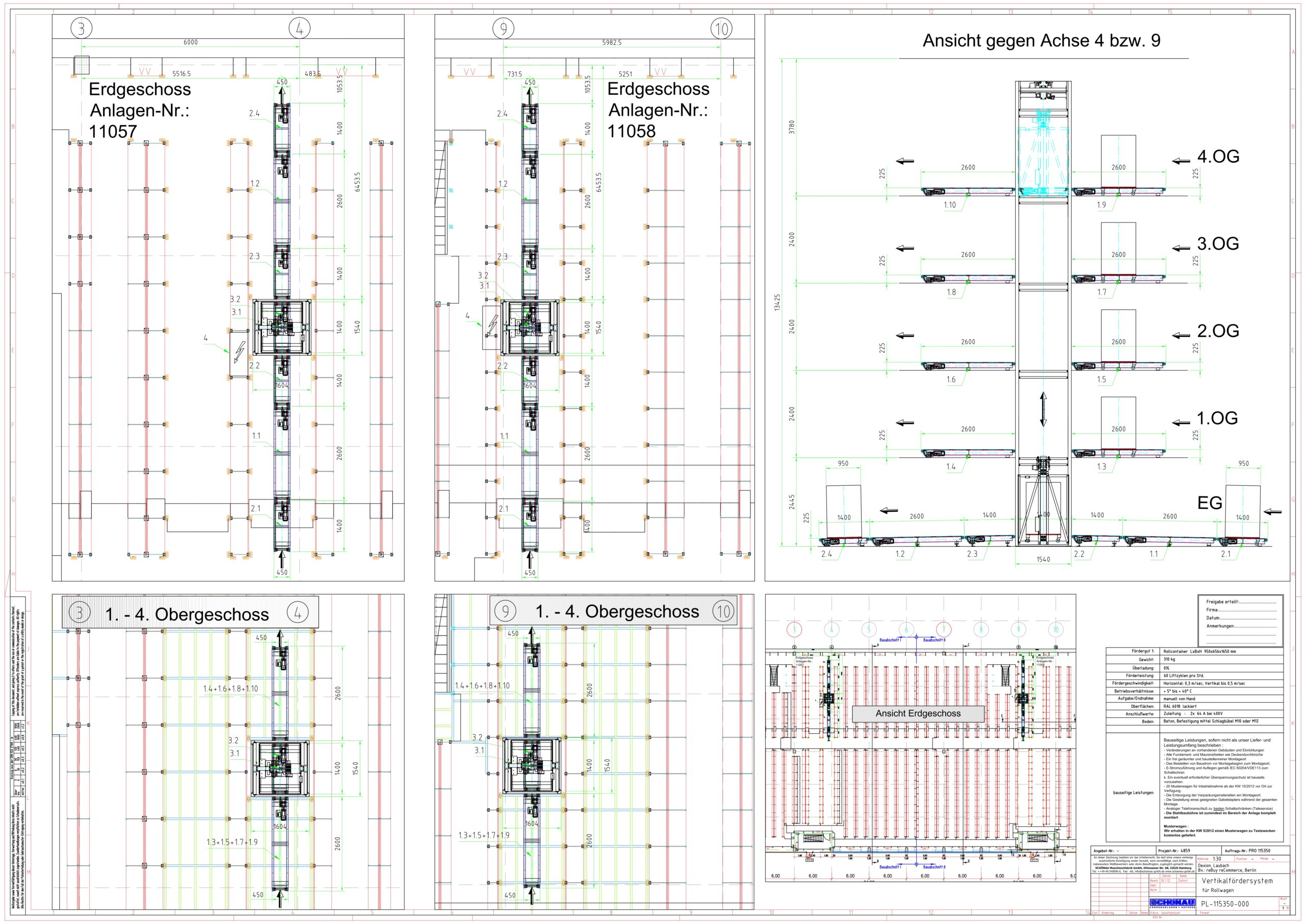
The shelving system is loaded using roll carts. Order picking is performed directly in the roll carts. The trolleys are transported between levels via a vertical conveyor system housed in a self-supporting shaft structure that is integrated into the racking platform; this system is based on our standard VGK2 goods elevator and is equipped with a frequency-controlled drive. On each level, there are low-profile, frequency-controlled belt conveyors located in front of and behind the vertical conveyor for incoming and outgoing goods, respectively.
Design Details
The necessary access to the vertical conveyor from both sides is perfectly and cost-effectively ensured at all levels by innovative telescoping sliding doors, which were developed in collaboration with our elevator division.
Control
The operator assigns a destination level to each trolley placed in the system with the push of a button. All trolleys in the system are tracked virtually, and an intelligent program running on a Siemens S7 controller organizes the transport operations according to a sophisticated system. A modem installed in the control cabinet—known as the remote maintenance port—allows the program and parameters to be adjusted when transport priorities need to be changed and also ensures rapid support in the event of general problems.